
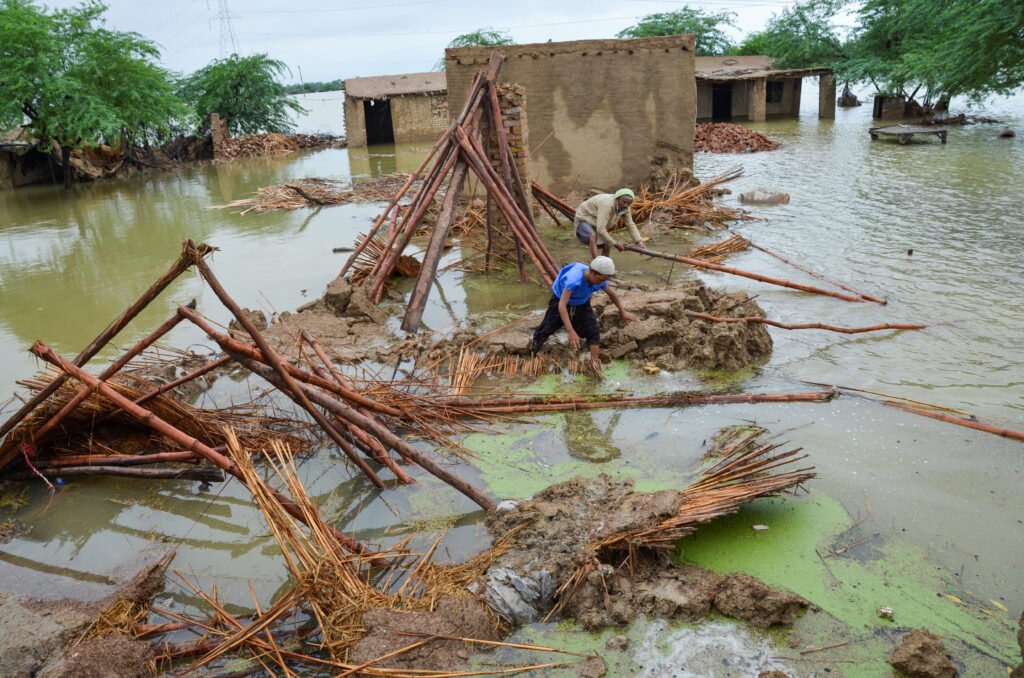
In August 2022, torrential rains turned large parts of Pakistan into an inland sea. Entire villages disappeared, roads were washed away, and families were forced to flee. A child in Sindh clung to a broken rooftop as her family searched for safety; in Balochistan, mothers carried infants through waist-deep water with no idea where to go. More than 33 million people were affected, millions lost their homes, and thousands lost their lives (World Bank, 2022).
Pakistan is among the most climate-vulnerable countries in the world (Eckstein et al., 2021). Floods, droughts, and heatwaves strike repeatedly, leaving behind cycles of destruction. Yet, the national response and global aid largely emphasize rebuilding infrastructure and addressing financial damages. The invisible wounds—the trauma, grief, and anxiety—remain neglected.
Research shows that disasters can trigger severe psychological conditions, including post-traumatic stress disorder (PTSD), depression, and long-term emotional distress (Ahmad et al., 2022). In Pakistan, with limited resources for mental health care, this silent crisis poses serious risks to recovery and resilience.
Climate disasters in Pakistan must therefore be recognized not only as environmental and economic crises but also as psychological emergencies. Ignoring trauma undermines both individual healing and collective preparedness for future disasters.
Pakistan’s Climate Disaster Landscape
Over the past two decades, Pakistan has faced repeated climate-related disasters. The 2022 floods alone displaced 33 million people, destroyed 2 million homes, and caused over $30 billion in damage (World Bank, 2022). Such figures highlight the intensity of the challenge.
Experts describe these events as “recurring shocks.” Even when floodwaters recede, families remain trapped in poverty, displacement, and insecurity (Khan et al., 2020). Crops and livestock are destroyed, schools remain closed, and people lose livelihoods.
The true cost cannot be measured only in broken bridges or collapsed houses. It is also carried in the emotional scars of survivors—farmers who cannot rebuild their land, children who drop out of school, and families who live in shelters year after year (Ali et al., 2021). Climate disasters in Pakistan are as much about scarred minds as shattered infrastructure.
The Overlooked Crisis: PTSD and Mental Health After Disasters
When disasters strike, most people focus on the visible damage. But what remains invisible are the psychological wounds. PTSD is one of the most common outcomes after disasters. It includes symptoms such as flashbacks, persistent fear, survivor’s guilt, and loss of security (American Psychiatric Association, 2013).
Globally, survivors of floods, hurricanes, and tsunamis often report long-term mental health struggles (Goldmann & Galea, 2014). In Pakistan, the problem is worse due to a weak mental health infrastructure. The country has fewer than 500 psychiatrists for a population of over 240 million (Saeed et al., 2020). Most of them are concentrated in cities, leaving rural disaster-hit areas without professional care. Cultural stigma worsens the crisis. Many survivors avoid seeking help because mental illness is often seen as weakness or superstition (Khalily, 2011). Displaced families living in tents face uncertainty, unemployment, and food insecurity, which increase depression (Javed et al., 2022). Even rainfall or thunder can trigger painful memories of loss. By neglecting mental health, disaster responses only rebuild walls, not lives. These untreated psychological wounds slow recovery and reduce resilience for future disasters.
Vulnerable Communities at the Front-line
Floods and droughts do not affect everyone equally. Some groups face greater risks and deeper trauma:
Children: Disasters disrupt their sense of safety. Losing homes, schools, or parents exposes them to PTSD, anxiety, and behavioral problems (Furr et al., 2010). Many children continue to fear water or heavy rains long after the floods.
Women: Women often care for children and elderly family members, while also facing risks of harassment or violence in shelters (Iqbal & Zakar, 2021). With little emotional support, they bear a double burden of physical and psychological trauma.
Elderly and disabled people: Limited mobility prevents them from evacuating quickly, increasing their suffering. Many elderly survivors report feelings of helplessness and loss of dignity after being displaced (Phibbs et al., 2016).
Rural poor: Farmers and laborers who depend on agriculture face devastating losses when fields and livestock are destroyed. This creates financial instability and deep emotional despair (Ali et al., 2021).
These examples show that vulnerability is not only physical but also deeply psychological. A disaster response that ignores these groups risks leaving them behind.
Why Pakistan Struggles with Mental Health Response?
Despite clear evidence, Pakistan’s disaster management still overlooks mental health. Several barriers explain this gap:
Policy blind spots: Agencies like NDMA and PDMA focus on rescue and rebuilding, but mental health is rarely included (Khan et al., 2021).
Resource shortages: With fewer than 500 psychiatrists nationwide, mental health care is almost absent in rural areas (Saeed et al., 2020).
Institutional gaps: No structured mental health units exist in disaster response teams. Survivors are left to cope on their own.
Cultural stigma: Psychological issues are dismissed as weakness or fate, discouraging people from seeking help (Khalily, 2011).
Donor priorities: International funding often supports roads, schools, and hospitals, while mental health programs receive little attention (Javed et al., 2022).
This neglect is shortsighted. Untreated trauma weakens communities, slows down economic recovery, and makes people less prepared for future disasters.
Why Addressing Trauma Matters?
Disasters destroy buildings, but trauma destroys resilience. Survivors who suffer from PTSD or depression often struggle with daily functioning, making it harder to return to work or rebuild livelihoods (Neria et al., 2008).
Trauma also affects future generations. Children of traumatized parents are at greater risk of emotional and behavioral problems (Field et al., 2013). In this way, untreated trauma creates cycles of vulnerability that extend across decades.
Addressing trauma is also essential for climate resilience. As disasters become more frequent, communities must be psychologically strong to cope and adapt. Healing minds is therefore as important as rebuilding infrastructure (Goldmann & Galea, 2014).
What Needs to Change: Building a Trauma-Informed Climate Response?
To build resilience, Pakistan must integrate mental health into disaster response.
Practical steps include:
Include mental health in disaster plans: Make psychosocial support part of NDMA and PDMA strategies, including screening, referral, and care pathways (Patel et al., 2018).Train responders in Psychological First Aid (PFA): First-line workers can provide immediate emotional support and connect survivors to care (Shultz & Forbes, 2014).
Task-shifting: Train community health workers and teachers to deliver simple interventions under supervision. The “Thinking Healthy” program already showed success in reducing maternal depression in rural Pakistan (Rahman et al., 2008).
Support vulnerable groups: Provide safe spaces for women and children, disability friendly facilities, and school-based programs to restore children’s sense of safety (Jordans et al., 2009).
Link psychosocial support with livelihoods: Pair mental health care with cash transfers or job programs. Evidence shows financial support reduces stress and improves well-being (Haushofer & Shapiro, 2016).
Use digital tools: Tele-mental health, SMS counseling, and mobile clinics can reach isolated areas (Naslund et al., 2017).
Monitor progress: Use simple screening tools to track distress and recovery (Kessler et al., 2002).
Invest and coordinate: Allocate 5–10% of disaster funds to mental health services and establish national coordination (Chisholm et al., 2016).
Protect frontline workers: Provide counseling and peer support to prevent burnout (Hobfoll et al., 2007).
These steps are cost-effective, practical, and essential for building resilience.
Conclusion
The devastating floods of 2022 exposed Pakistan’s vulnerability to climate change, and the 2025 floods again displaced millions across Punjab, Khyber Pakhtunkhwa, and Gilgit-Baltistan (Reuters, 2025; Dawn, 2025). While houses and farms can be rebuilt, the hidden trauma—fear, grief, and insecurity—remains long after the waters recede.
Climate disasters are not only environmental or economic but also psychological emergencies. Ignoring trauma weakens recovery and risks passing suffering to future generations.
To heal, Pakistan must adopt a trauma-informed disaster response. Policymakers, NGOs, and international donors should integrate mental health into recovery plans, train responders in Psychological First Aid, and support community-based care.
Rebuilding Pakistan after floods means more than replacing bricks and roads—it means restoring hope. True resilience will come only when we rebuild both homes and minds.
References
Ahmad, I., Ullah, I., & Ahmad, M. (2022). Prevalence of post-traumatic stress disorder among flood survivors: A systematic review and meta-analysis. BMC Psychiatry, 22(1), 421. https://doi.org/10.3389/fpsyt.2022.890671
Ali, A., Khan, A., & Raza, H. (2021). Climate change and human security in Pakistan: The case of recurring floods. Environmental Development, 40, 100668.
https://socialsignsreivew.com/index.php/12/article/view/204
American Psychiatric Association. (2013). Diagnostic and statistical manual of mental disorders (5th ed.). American https://doi.org/10.1176/appi.books.9780890425596 Psychiatric Publishing. Chisholm, D., Sweeny, K., Sheehan, P., Rasmussen, B., Smit, F., Cuijpers, P., &
Saxena, S. (2016). Scaling-up treatment of depression and anxiety: A global return on investment analysis.The Lancet https://doi.org/10.1016/S2215-0366(16)30024-4 Psychiatry, 3(5), 415–424.
Dawn. (2025, August). Floods displace millions across Pakistan. Dawn News. Eckstein, D., Künzel, V., Schäfer, L., & Winges, M. (2021). Global Climate Risk Index 2021: Who suffers most from extreme weather events? Germanwatch. Field, N. P., Muong, S., & Sochanvimean, V. (2013). Parental styles in the intergenerational transmission of trauma stemming from the Khmer Rouge regime in Cambodia. American Journal https://doi.org/10.1111/ajop.12057 of Orthopsychiatry, 83(4), 483–494.
Furr, J. M., Comer, J. S., Edmunds, J. M., & Kendall, P. C. (2010). Disasters and youth: A meta-analytic examination of posttraumatic stress. Journal of Consulting and Clinical Psychology, 78(6), 765–780. https://doi.org/10.1037/a0021482 Goldmann, E., & Galea, S. (2014). Mental health consequences of disasters. Annual Review of Public Health, 35, 169–183. https://doi.org/10.1146/annurev-publhealth 032013-182435
Haushofer, J., & Shapiro, J. (2016). The short-term impact of unconditional cash transfers to the poor: Experimental evidence from Kenya. The Quarterly Journal of Economics, 131(4), 1973–2042. https://doi.org/10.1093/qje/qjw025 Hobfoll, S. E., Watson, P., Bell, C. C., Bryant, R. A., Brymer, M. J., Friedman, M. J., Ursano, R. J., & Zatzick, D. F. (2007). Five essential elements of immediate and mid-term mass trauma intervention: Empirical evidence. Psychiatry, 70(4), 283–315. https://doi.org/10.1521/psyc.2007.70.4.283
Murtaza,T., Ashraf, R., Ashfaq, M, U& Ahmad, A. (2025). Gender disparities and climate change: A grounded study from Okara. Social Sciences Spectrum, 4(2), 547 558. https://doi.org/10.71085/sss.04.02.291
Javed, A., Khan, M. N., & Yasir, A. (2022). Post-disaster mental health challenges in Pakistan: The case of 2022 floods. Asian Journal of Psychiatry, 74, 103207. https://doi.org/10.1016/j.ajp.2022.103207 Oudeh, A. (2023). Children of war: a clinical research portfolio of trauma profiles and interventions (Doctoral dissertation, University of Glasgow).
Khalily, M. T. (2011). Mental health problems in Pakistan: An overview. Asian Journal of Psychiatry, 4(3), 225–228. https://doi.org/10.1016/j.ajp.2011.05.009 Khan, M. M., Ahmed, A., & Khan, S. (2021). Disaster management and the neglect of mental health in Pakistan: Policy gaps and challenges. International Journal of Disaster Risk Reduction, 64, 102485. https://doi.org/10.1016/j.ijdrr.2021.102485 Kessler, R. C., Andrews, G., Colpe, L. J., Hiripi, E., Mroczek, D. K., Normand, S. L. T., Walters, E. E., & Zaslavsky, A. M. (2002). Short screening scales to monitor population prevalences and trends in non-specific psychological distress. Psychological Medicine, https://doi.org/10.1017/S0033291702006074 32(6), 959–976.
Naslund, J. A., Aschbrenner, K. A., Araya, R., Marsch, L. A., Unützer, J., Patel, V., & Bartels, S. J. (2017). Digital technology for global mental health: Opportunities for low- and middle-income countries. The Lancet Psychiatry, 4(6), 486–500. https://doi.org/10.1016/S2215-0366(17)30096-2
Neria, Y., Nandi, A., & Galea, S. (2008). Post-traumatic stress disorder following disasters: A systematic review. Psychological Medicine, 38(4), 467–480. https://doi.org/10.1017/S0033291707001353
Patel, V., Saxena, S., Lund, C., Thornicroft, G., Baingana, F., Bolton, P., Chisholm, D., Collins, P. Y., Cooper, J. L., Eaton, J., Herrman, H., Herzallah, M. M., Huang, Y., Jordans, M., Kleinman, A., Medina-Mora, M. E., Morgan, E., Niaz, U., Omigbodun, O., … Unützer, J. (2018). The Lancet Commission on global mental health and sustainable development. The Lancet, https://doi.org/10.1016/S0140-6736(18)31612-X 392(10157), 1553–1598.
Phibbs, S., Kenney, C., Severinsen, C., Mitchell, J., & Hughes, R. (2016). Synergising public health concepts with the Sendai Framework for Disaster Risk Reduction: A conceptual glossary. International Journal of Environmental Research and Public Health, 13(12), 1241. https://doi.org/10.3390/ijerph13121241
Rahman, A., Malik, A., Sikander, S., Roberts, C., & Creed, F. (2008). Cognitive Behaviour therapy–based intervention by community health workers for mothers with depression in rural Pakistan (Thinking Healthy Programme): A cluster-randomised controlled trial. The Lancet, 372(9642), 902–909. https://doi.org/10.1016/S0140 6736(08)61400-2
Reuters. (2025, August). Pakistan floods displace millions. Reuters. Saeed, K., Gater, R., Hussain, A., & Mubbashar, M. H. (2020). Scaling up mental health services in Pakistan: A global health priority. Health Policy and Planning, 35(2), 202–208. https://doi.org/10.1093/heapol/czz144 World Bank. (2022). Pakistan floods 2022: Post-disaster needs assessment. The World Bank Group. https://doi.org/10.1596/978-1-4648-1905-