

The tale of a state wounded by National disintegration, political divisions, ethnic hatred, terrorism, economic turmoil and sectarian schisms is one of resilience; amidst chaos arose a ray of hope promising prosperous prospect.
A recent suggestion about restructuring Pakistan’s administrative structure has gain potential attention from mainstream media criticizing the current administrative structure to be inefficient and ineffective considering massive population size of 251.3million people. Under this idea, Pakistan could be reorganized into 12 provinces of around 20 million people each, 15–20 provinces of 12–16 million people each, or even 38 provinces with about 6 million people each.
Globally, many states have devolved power into smaller administrative units to promote economic growth, strengthen local representation, ensure regional development, and achieve more equitable distribution of resources. Smaller units tend to improve public service delivery in areas such as health, education, and infrastructure by reducing bureaucratic bottlenecks and bringing governance closer to citizens. Creating smaller administrative units based on population could lead to more effective resource allocation and development in under-served regions building grounds for emerging political parties to challenge the dominance of dynastic and populist forces, thereby enhancing political competition, transparency, accountability, and governance. Such restructuring may also contribute to conflict management and national cohesion, by reducing feelings of exclusion and distributing power more evenly across diverse regions. This division has multi-dimensional implications having ability to provide solution for multi-dimensional problems of society.
Vietnam, with 100 million people, has 58 provinces; the United States, with over 340 million, has 50 states; and Russia, with around 140 million, has 85 federal subjects. Within Pakistan, Punjab alone has a population larger than that of the Philippines (116.1 million), Sindh exceeds Sri Lanka (23.1 million), and Khyber Pakhtunkhwa (40.9 million) outnumbers Austria (9.1 million).
The impetus for provincial restructuring in Pakistan emerges from deep-seated inter- and intra-regional asymmetries in socio-economic development and progress. Stark socio-economic inequalities exist both between provinces and within them, reflected in unequal access to assets, income, education, health, rights, and opportunities for decent work. According to NDHR report 2020 Income inequality is striking: in 2018–2019, the poorest 1 percent of the population held only 0.15 percent of national income, while the richest 1 percent controlled 9 percent. Similarly, disparities in human development are profound, the HDI value of the richest 20 percent of Pakistanis is 0.698, placing them in the high human development category, whereas the poorest 20 percent record an HDI value of just 0.419, corresponding to low human development.
NDHR Inequality Report 2020: https://www.undp.org/sites/g/files/zskgke326/files/migration/pk/NHDR-Inequality-2020—Overview-Low-Res.pdf
These inequalities are not evenly spread across the country. Balochistan and Sindh are disproportionately represented among the poorest 20 percent of the population relative to their overall share of the national demographic. Within provinces, the gaps are equally wide. Punjab, the most populous province, hosts some of Pakistan’s best education and health facilities, yet the richest 20 percent of its people enjoy a GDP per capita 5.2 times higher, and an HDI 1.6 times greater, than the poorest 20 percent. In Sindh, despite its status as an economic hub with ports and trade networks, the richest quintile’s GDP per capita is 5.3 times higher, and their HDI 1.8 times greater, than that of the poorest quintile. Similarly, the richest in Khyber Pakhtunkhwa earn nearly four times more, with an HDI 1.4 times greater, while in Balochistan, the richest 20 percent hold a GDP per capita 3.7 times higher, and an HDI 1.8 times greater, than the poorest segment.
These disparities reflect not only economic imbalance but also structural weaknesses, where over-centralization and elite capture of resources have accentuated inequality and limited local accountability. The persistence of these disparities reflects what scholars describe as a “governance deficit,” where state structures fail to translate resources into inclusive development outcomes. Provincial restructuring is increasingly seen as a practical strategy to correct these imbalances by creating smaller, more responsive units better able to deliver public services, strengthen representation, and address regional grievances.
A closer examination of poverty distribution across Pakistan’s provinces recorded by Pakistan Poverty Alleviation fund highlights the sharp regional disparities that underpin demands for administrative restructuring.
(PPAF Annual Report 2024): https://www.ppaf.org.pk/doc/PPAF%20Annual%20Report%202024.pdf
Punjab, the province is often divided into Southern, Central, and Northern regions to capture variations in development. Southern Punjab particularly Bahawalpur, Dera Ghazi Khan, Rajanpur, and surrounding districts records the highest poverty levels, with ratios ranging from 68.6 to 49.3 percent, while districts such as Bahawalpur, Rahim Yar Khan, and Vehari fall in the high-poverty range of 48.4 to 34.6 percent. Central Punjab presents a mixed picture, with areas like Sahiwal, Pakpattan, and Khanewal showing moderate poverty rates of 33.6 to 19.2 percent. By contrast, Northern Punjab is comparatively prosperous, with districts such as Gujranwala exhibiting the lowest poverty levels (19.3 to 3.2 percent) alongside stronger educational, health, and infrastructural outcomes.
In Sindh, the disparities are equally stark. Karachi and Hyderabad fall within the low-poverty zone (19.3 to 3.2 percent), while districts such as Sujawal, Thatta, Badin, Tharparkar, and Umer Kot are among the poorest in the country, with poverty ratios as high as 91.2 to 68.7 percent. Other divisions show intermediate conditions: Kashmore, Larkana, Jacobabad, and Khairpur fall in the 68.6 to 49.3 percent bracket, while Dadu, Jamshoro, and Sanghar record poverty between 48.4 and 34.6 percent. Only Sukkur and parts of Larkana register somewhat better conditions, with poverty levels ranging from 33.6 to 19.2 percent.
Khyber Pakhtunkhwa (KP) exhibits similar internal contrasts. The former tribal districts and remote northern areas, including North and South Waziristan, Kurram, Kohistan, Orakzai, and Bajaur, record extreme poverty, with rates ranging from 91.2 to 49.3 percent. Districts such as Lower Dir, Battagram, and Shangla also fall within high-poverty zones (68.6–49.3%). In contrast, moderate poverty is observed in Buner, Lakki Marwat, and Bannu (48.4–34.6%), while relatively prosperous districts such as Peshawar, Abbottabad, and Haripur fall into the low-poverty category (19.3–3.2%).
Balochistan presents the most severe picture overall, with the majority of its districts falling within the extreme poverty range. Chaghi, Washuk, Panjgur, Awaran, Kohlu, Dera Bugti, and Killa Saifullah register poverty between 91.2 and 68.7 percent, while Khuzdar, Loralai, and Kalat fall in the 68.6 to 49.3 percent bracket. Only a handful of districts Gwadar, Mastung, and Ziarat record poverty levels between 48.4 and 19.2 percent, with Quetta as the sole district in the low-poverty zone (19.3–3.2%).
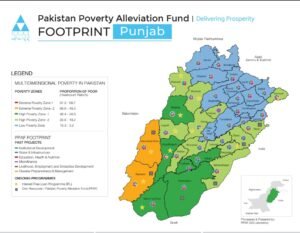
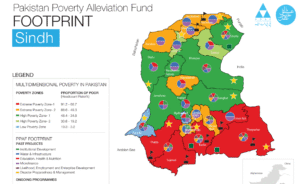
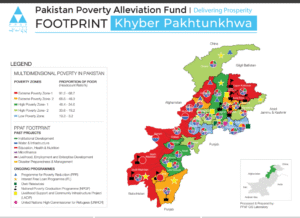
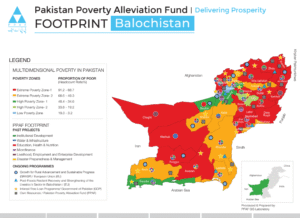
These patterns reveal how poverty in Pakistan is deeply regionalized, with Southern Punjab, interior Sindh, peripheral KP, and almost all of Balochistan bearing the greatest burden of deprivation. The concentration of poverty in geographically marginalized areas highlights a persistent failure of equitable resource allocation, service delivery, and local representation.
Punjab, despite its disproportionately large population, exhibits relatively better socio-economic indicators seen by some as a legacy of colonial-era development but regional regional-asymmetries are stark. However, other provinces exhibit worse socio-economic indicators and require administrative restructuring to effectively confront governance challenges and address deep-rooted disparities.
The foremost obstacle to meaningful restructuring of the state is the role of political parties. A cynical interpretation is that political parties manipulate ethnic identities, cultural narratives, and popular grievances to preserve power for narrow elite circles. A more benign view, however, is that they act as channels for people’s cultural beliefs and identities, particularly when these intersect with perceptions of inequality and injustice. The continuation of only four provinces is not merely due to long-standing administrative inertia but also shaped by the influence of linguistic and cultural politics. The creation of new provinces thus depends less on the logic of equitable governance and more on the narratives parties build, the consent they manufacture, and the constituencies they seek to secure.
A second major obstacle lies in the deepening national fragmentation and widespread skepticism toward the state. Pakistan is experiencing not only economic and political turmoil but also heightened ethnic divisions that have eroded trust in state institutions. Public perceptions increasingly view state policies as exploitative, discriminatory, and unjust, such that even well-intentioned reforms are often interpreted as mechanisms of further extraction. The state, once seen as a protective entity, is now regarded with suspicion. Restoring trust requires the establishment of strong, empowered, and autonomous local governments, as inclusive grassroots representation can play a pivotal role in bridging socio-economic inequalities between urban and rural regions.
Administrative restructuring is not merely a matter of improving governance efficiency; it has become a question of national survival and identity. Redrawing provincial boundaries in ways that prevent any single ethnicity from achieving political dominance can mitigate the risk of ethno-nationalist hegemony and strengthen Pakistan’s fragile federation. At the same time, this moment provides an opportunity to undermine the politics of ethnic hatred that thrives on division, scapegoating, and the evasion of accountability. Yet, such reforms cannot succeed without first addressing the grievances of marginalized movements. The state must reconsider its approach to dissent, prioritizing strategies that disarm the grievances and perceptions fueling discontent in people’s minds rather than merely attempting to suppress weapons in their hands. Durable peace cannot be achieved through coercion alone; it requires addressing the root causes of alienation such as inequality, political exclusion, and perceived injustices. Without this trust-building, even the most sincere proposals for reform will wither under suspicion, misinformation, and resentment.
YOP RESEARCHER Aiman Anwar is an undergraduate researcher specializing in Political Science at Quaid-i-Azam University, Islamabad. With a keen interest in exploring complex political dynamics, I’m dedicated to developing my research skills and contributing to informed policy discourse. My academic pursuits and research experiences are geared towards analyzing pressing issues and fostering evidence-based solutions.