
There are global problems that affect all countries and require a collective and synergistic effort to address them. The countries are making strategies to cope with those problems. In this sequence, the UN has internationally introduced some goals to make the world sustainable and a better place to live for future generations. These goals are 17 with 169 targets and are called SDGs (Sustainable Development Goals). Their objectives are to give people prosperity and peace on the planet. These goals were based on the 2030 Agenda for a sustainable society. It works in all areas, e.g. social, economic and biosphere, to make the earth worth living and a comparatively happy place. These 17 SDGs fall under these three categories.
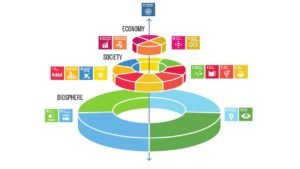
First, the Biosphere, which is listed under SDG number 6 clean water and sanitation, 13 climate action,14 life below water, and 15 life on land. Second, society which includes 1 No poverty, 11 sustainable cities and communities, 16 peace justice and strong institutions, 7 affordable and clean energy, 3 good health and well-being, 4 quality education, 5 gender equality, 2 zero hunger. The Economy is focused on 8 decent work and economic growth, 9 industry innovation and infrastructure, 10 reduced inequalities, 12 responsible consumption and production, and 17 partnerships for the goals.
In this article, we focus on SDG 13 (climate action), why the climate is becoming worse with time, even though we are working on the SDGs, especially on 13 (climate action), which specifically focuses on taking urgent action to combat climate change. The collapse compels us to think about it and find out what the shortcomings are that hinder their effectiveness in mitigating climate change.
“The climate crisis is a test of global solidarity, and our response will define the future of humanity” (UN Secretary-General)
One of the important steps taken in this regard is the Paris Pact 2015, which calls for maintaining the average temperature surge of 2 degrees Celsius above pre-industrial times. Whereas the ideal temperature limit is suggested to be 1.5 degrees Celsius. However, this specific task is yet to be accomplished.
Later, another significant step was taken in 2016: The Kigali amendment to the Montreal Protocol on substances that deplete the ozone layer. Despite all this, there is no momentous change, as Lindsay Maizland wrote in an article where experts say, “States are not doing enough to combat the alarming global warming.” Climate change also affects the implementation and progress of all other SDGs.
Climate change is a significant contributor to humanitarian emergencies. (WHO)
Shortcomings: Implementation Barriers
Some factors are hindering the progress of the SDGs in combating climate change.
-
Insufficient climate action:
One of the most significant contributing factors is insufficient climate action. It is written in the UN Environment program report that the planet is out of the way to meet climate action goals (report prepared by a new multi-agency coordinated by the World Meteorological Organization, WMO). According to the UN in a science report, only 15% of the SDGs are on target. In the Emission Gap Report (UNEP) 2023 by the UN Environment Program, there is an increase of 1.5 degrees temperature, which exceeds the limit given in the Paris Agreement.
Climate action trackers evaluate most countries as highly insufficient to fulfil their commitments and actions needed to combat climate change.
-
Systematic gaps in building frameworks:
There is no binding framework for the implementation of climate action, it is a voluntary commitment of the countries. There is a lack of enforcement to strengthen the mechanism. Sustainable goals are implemented in fragments. One goal conflict with other goals, which we say are misaligned incentives (IPCC AR6 synthesis report). For example, the economic growth Goal 8 conflicts with climate action goals 13 and 15, and ecosystem protection. Also, SDG 13 did not fully integrate with SDG 2 (zero hunger), 7(affordable energy) 9 (industry). Climate policies sometimes neglect the interdependencies of agriculture, infrastructure, and urban areas, diminishing the impact of overall climate action. Where one goal hinders the progress of others, these goals are supposed to be achieved in isolation, which is impossible. (UN Sustainable Development Report 2024).
-
Funding gaps and economic and political barriers:
The article “Environmental protection or economic growth?” discusses a study from a Czech university indicating that economic development in developing countries is linked to environmental decline. This creates a trade-off that hinders achieving climate goals.
In the report ‘The global landscape of climate finance 2021’ by Buchner, it is reported that for the world, USD 4.5 to 5 trillion annually is needed to combat climate change. It has been analyzed in the report that the funding is raised, but it cannot be aligned with the growing climate crisis. It is also emphasized that developing countries lack sufficient funding for green development. They need USD 155 to 300 billion annually by 2030 to address their needs alone.
The report also highlights that there is misalignment in the implementation of climate action. Given that fossil fuel investment amounts to USD 850 billion annually, it fails to demonstrate the positive impact of climate finance on decarbonizing energy.
Governments tend to prioritize policies that deliver immediate results over long-term strategies. For example, in 2014, the Australian government waived taxes on carbon, a measure intended to reduce the greenhouse effect, but this led to an increase in emissions, as reported by the Climate Action Tracker.
-
Data scarcity makes it harder to identify issues:
The IPCC AR6 synthesis report, 2023, highlights a lack of reliable data, making it challenging to analyze the climate crisis and assess the effectiveness of policies aimed at addressing it. Verified and updated statistics are necessary to solve any complications.
Conclusion
From the above analysis, it is concluded that to mitigate the gaps which are hindering the progress of the SDGs, governments must take strong and immediate steps which focus on long-term policies to cope with problems. All countries should take responsibility for the increasing temperature and work with a collective effort.
Also, there is a need to amend the framework of the SDGs goals to make them binding on all countries of the world and impose penalties if violated anywhere by anyone.

Abeera Ikram, a third-year Law student at Quaid-i-Azam University, Islamabad, committed to advocating for social justice and addressing pressing societal challenges. I actively research issues affecting vulnerable groups and seek to promote legal awareness and reforms. I published an article, “Behind Closed Doors: Domestic Spousal Violence on Women”( Asian Politico), which reflects my dedication to giving voice to marginalised communities and driving meaningful change. I am also passionate about addressing systematic gaps in global policies.